
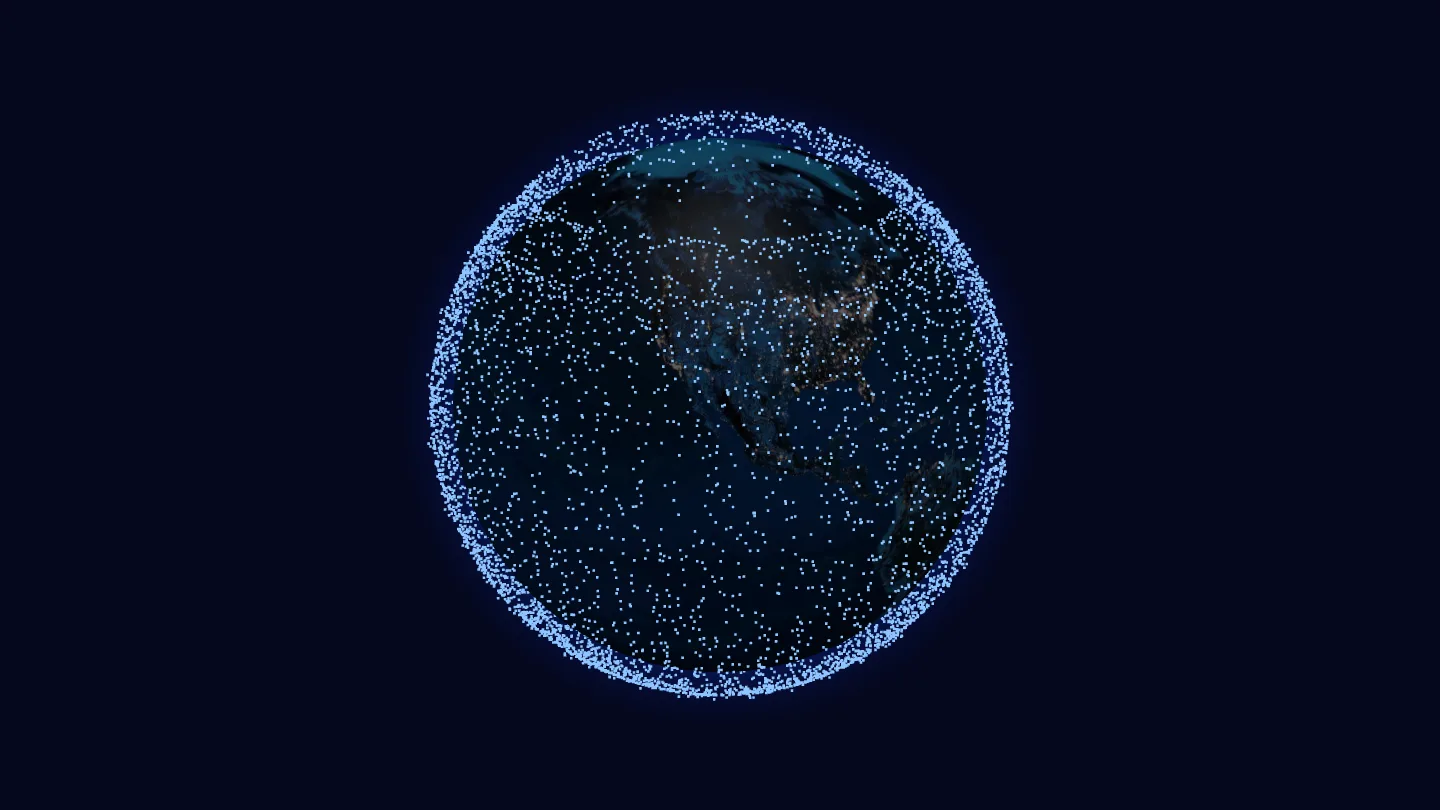
Traditional aviation satcom orbits at 22,236 miles. Starlink orbits at roughly 340. Almost every difference passengers notice between the old cabin and the new one traces back to that one number.
It is worth understanding, because it explains why the technology arrived so abruptly, why it is expensive, and why the tradeoffs are shaped the way they are.
The geostationary bargain
Park a satellite at 22,236 miles above the equator and it orbits at exactly the speed the Earth turns. From the ground it appears to hang perfectly still. That is a remarkable piece of engineering, and it made satellite communications practical for decades: point a dish once, never move it again, and three satellites cover most of the planet.
The cost of that convenience is distance. A signal from your laptop to a geostationary satellite and back down to a ground station, then all the way back again with the reply, travels roughly 90,000 miles. Light is fast, but it is not infinitely fast. You get a round trip delay of about 500 to 700 milliseconds before the network has done any actual work.
Half a second does not sound like much. It is enough that two people on a video call interrupt each other constantly, that a remote desktop feels like typing through syrup, and that most modern web applications, which make dozens of sequential requests to render a single screen, feel broken rather than slow.
The low earth orbit trade
Drop to 340 miles and the round trip falls to somewhere around 25 to 50 milliseconds. The network disappears from the user's awareness, which is the actual goal.
But a satellite at that altitude does not hang still. It crosses the sky in minutes. To hold a connection you need three things that did not exist affordably until recently:
- Thousands of satellites, so that another one is always overhead. This is why the constellation had to be built before the service could be sold.
- An electronically steered antenna, which redirects its beam through phased array electronics rather than physically moving a dish. On an aircraft doing 450 knots while the satellite crosses the sky, mechanical steering is not viable.
- Handoffs measured in milliseconds, as the terminal releases one satellite and acquires the next without the session noticing.
The flat plate on top of a modern aircraft is not a dish that happens to be flat. It is a computer that steers a radio beam electronically, thousands of times faster than anything mechanical could.
What that means in the cabin
Starlink Aviation quotes speeds up to 500 Mbps on regional plans and up to 1 Gbps on global service. In practice, the number that matters is that the cabin behaves like a decent office network. Video calls hold. Cloud files sync. Streaming does not buffer at the interesting part. Several passengers and the crew can all be doing real work at once, which is where older systems fell apart even when their peak speed looked acceptable on paper.
Why the installation is the hard part
The terminal is a product. Putting it on a certified aircraft is a program.
An installation requires engineering against approved technical data for that specific airframe, a mounting and wiring kit built to fit it, structural and electrical integration, ground and inflight validation testing, then documentation and logbook sign off. On aircraft without an existing supplemental type certificate, that certification path is the long pole, not the hardware.
This is exactly why high throughput connectivity landed first on ultra long range aircraft. The certification work costs roughly the same whether the airframe is a $70 million flagship or a midsize jet, so it was done first where the budgets were largest.
The part that is changing
As approved data becomes available for more midsize airframes, the economics invert. SatCon completed the world's first Starlink installation on a Hawker 800XP in March 2025 and now runs promotional installations starting at $75,000, with additional certification work underway on airframes including the Falcon 900, Challenger 850, Phenom 100, Learjet 45, and Learjet 60.
The physics stopped being the obstacle a while ago. The paperwork is what is opening now.
Last reviewed and updated on by the SatCon team.